
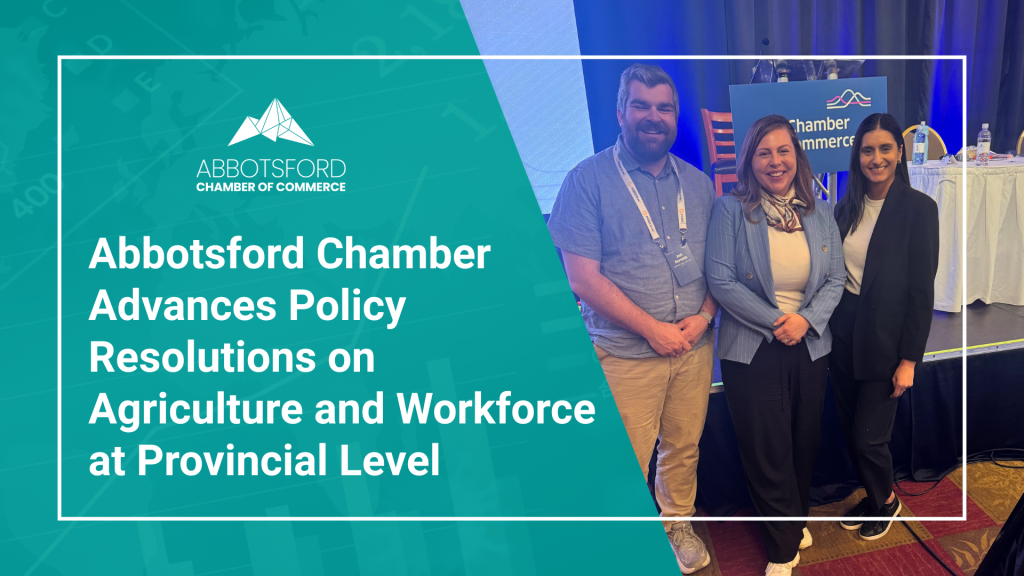
The Abbotsford Chamber of Commerce attended the BC Chamber AGM June 1 to 3 2026 in Fort St John where two policy resolutions advanced by the Abbotsford Chamber on Stabilizing PAL Allocations and Eliminating the 50 50 Rule were adopted by the provincial Chamber network.
FOR IMMEDIATE RELEASE
(Abbotsford, B.C.) June 8th, 2026 — The Abbotsford Chamber of Commerce attended the BC Chamber of Commerce Annual General Meeting and Policy Conference last week, joining business and community leaders from across British Columbia to discuss key economic issues and help shape advocacy priorities for the year ahead.
The Abbotsford Chamber of Commerce was represented by President Sam Varing, Vice President Josh Reynolds, and CEO Alex Mitchell, who advanced two policies focused on addressing key challenges to the Abbotsford Business Community:
This policy calls on the Province to improve the stability and predictability of Provincial Attestation Letter (PAL) allocations for post-secondary institutions. Recent federal reductions have constrained international student intake, creating uncertainty for institutions and regional employers who rely on international students as part of the broader workforce pipeline.
International students are essential to meeting labour market needs in high-demand sectors and supporting regional economies, particularly in areas such as aviation, logistics, advanced manufacturing, and agri-food in the Fraser Valley. A more stable and predictable PAL framework would strengthen workforce alignment, improve institutional planning, and better reflect regional labour market demand and institutional capacity.
Eliminating the 50-50 Rule to Strengthen Food Security and Agrifood Processing in B.C.
This policy calls on the Province to modernize the Agricultural Land Reserve (ALR) regulatory framework by eliminating the 50-50 rule for on-farm processing.
The current requirement, which mandates that at least half of inputs processed on ALR land be sourced from the same property, limits year-round operations, reduces scalability, and creates barriers to investment in B.C.’s agrifood processing sector. These constraints restrict operational efficiency and weaken provincial food system resilience.
Modernizing the policy would enable year-round processing, improve supply chain flexibility, and strengthen B.C.’s capacity to respond to climate disruption, trade uncertainty, and labour pressures. It would also support increased investment in value-added agriculture and reduce reliance on external processing markets, while maintaining strong protections for high-quality farmland.
“Strong advocacy starts with listening to our members and bringing their priorities to the tables where decisions are made,” said Sam Varing, President, Abbotsford Chamber of Commerce. “These resolutions reflect key challenges facing Abbotsford businesses, and our team will continue advancing them, alongside other member priorities, through ongoing engagement with government and the BC Chamber network. We are committed to ensuring Abbotsford’s business community has a strong and effective voice in shaping policies that support growth and competitiveness.
Abbotsford’s continued engagement at the provincial level ensures that the voices of Abbotsford businesses are at the table to shape provincial business advocacy to government. These policies allow Abbotsford to continue to push for pro-business changes in B.C.
###